A high-stakes power struggle has erupted inside Bombay House, the historic headquarters of the $165-billion salt-to-software Tata conglomerate. In a stormy board meeting that has drawn comparisons...






A decade ago, Rapido's entire business idea fit into one sentence: a motorcycle has a spare seat, its owner could use some extra cash, and a stranger nearby needs an affordable ride. That simple...

For decades, global aerospace giants viewed India primarily as an airline sales showroom—a booming passenger market where carriers place record-shattering aircraft orders with European and American...
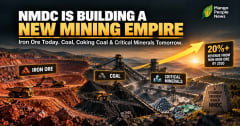
For nearly seven decades, NMDC has meant one thing to India: iron ore. The state-run miner supplies roughly a fifth of the country's entire iron ore needs — the raw material that goes into every...


When ordinary citizens, businesses, and investors encounter legal disputes—whether related to tax assessments, company insolvency, green clearances, or debt recovery—they rely on specialized courts...

Prime Minister Narendra Modi's Independence Day address from the Red Fort was more than a political speech. For businesses and investors, it offered a fairly clear map of where the government wants...

The Trade That Looked Like It Could Never Go Wrong Imagine a trade so obvious that almost everyone wants in. Artificial intelligence is the biggest technological revolution since the internet. AI...


One of the most expensive lessons in equity investing has nothing to do with picking the wrong company. It's failing to distinguish between an extraordinary business and a profitable investment. You...

"The market is at an all-time high. Should I pause my SIP and wait for a crash?" This is, hands down, the single most common question financial advisers hear. It feels intuitively wrong to buy...

"Rupee hits all-time low against the US Dollar" is one of those headlines that sounds like a national emergency. It conjures an image of the country's wealth quietly evaporating overnight. In...


When foreign tech giants like OpenAI (creators of ChatGPT), Google, and Anthropic build artificial intelligence, they build it primarily for English-speaking Western users. While these tools can...

In Steven Spielberg's classic sci-fi thriller Jurassic Park, the catastrophic breakdown occurred not because humans couldn't create dinosaurs, but because they assumed electric fences, security...

Any direct comparison between India and China’s semiconductor capabilities today is fundamentally misleading. China already possesses a massive, end-to-end chip ecosystem spanning design,...