Flipkart's Food Delivery Bet, Explained
Training Wheels, Not A Standalone Launch
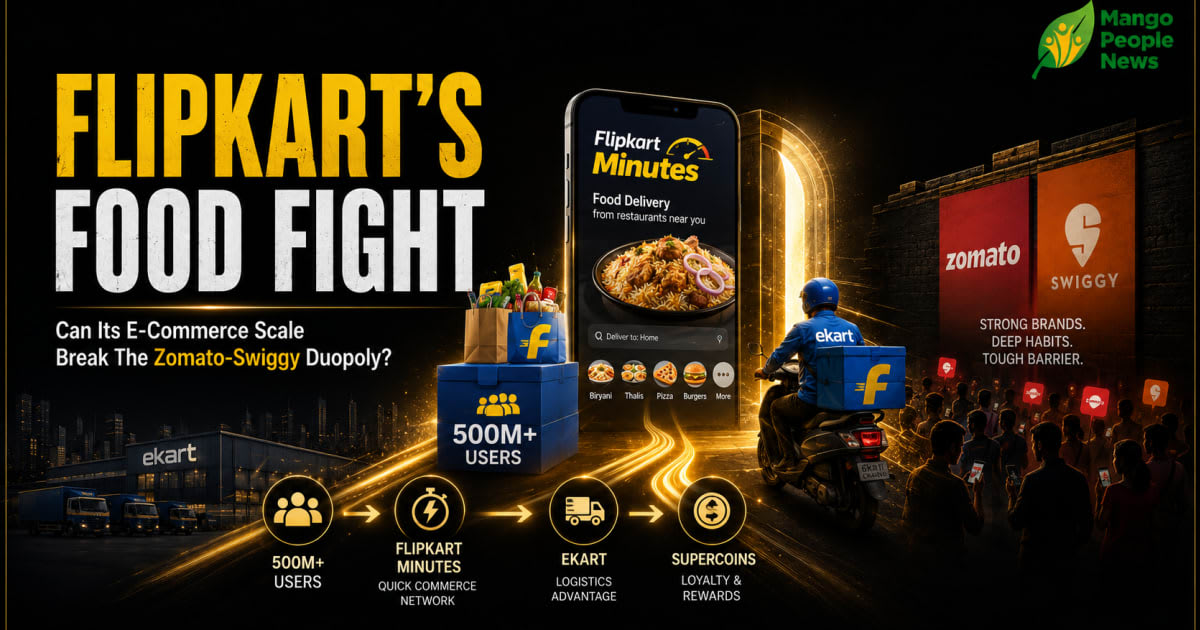
Flipkart isn't starting its food delivery business from scratch on day one — it's starting it inside an app it already runs. As the Walmart-owned company closes in on a full Bengaluru launch by end-August, with other cities expected to follow later this year, the as-yet-unnamed food delivery vertical will initially live inside Flipkart Minutes, the company's existing quick commerce app. A standalone food delivery app is reportedly also in the works and could arrive in the coming months, but for the initial rollout, Minutes will handle order placement and fulfilment — easing customer acquisition by tapping an audience that's already there.
This two-pronged approach — starting inside an existing app before eventually spinning out a dedicated one — mirrors exactly what Rapido did with its own food delivery platform, Ownly, earlier this year. Rapido later folded Ownly into its main ride-hailing app to widen access to its existing rider and rider-user base. Flipkart appears to be borrowing the same playbook.
Walking Into A Restaurant Revolt
The timing of Flipkart's entry is not incidental. It lands in the middle of a genuine standoff between restaurants and the Zomato-Swiggy duopoly — one that has been building for weeks, not months.
Industry bodies including the Bengaluru Hotels Association and the National Restaurant Association of India (NRAI) have been in direct conflict with Swiggy and Zomato over practices restaurant owners say are squeezing their margins: automatic opt-ins into advertising campaigns, no real ceiling on how much they can be made to spend on ads, and a lack of vernacular-language support when disputes arise.
NRAI president Sagar Daryani laid out the core restaurant demands plainly: the ability to opt out of ad campaigns, a hard cap on marketing spend, and dedicated regional-language support from the platforms. Some of this has reportedly been acknowledged in recent conversations between restaurant bodies and the two platforms — but the core issue, commission rates that Daryani says can run as high as 30-40%, remains untouched.
Daryani was blunt about what this actually costs a restaurant: once you stack commission, advertising and other charges together, the overall cost of doing business on the existing platforms can climb to 30-40% of every order — a level he calls unsustainable for many of his association's members. Officially, base commissions on Swiggy and Zomato range from 15% to 40%, but restaurants say the effective take rate runs considerably higher once platform fees, ad spends and payout deductions get layered on top.
Flipkart is reportedly targeting a base commission in the 12-13% range — meaningfully below what restaurants currently pay, especially those heavily dependent on the two incumbents for order volume. That gap is walking straight into an already-open wound.
What Flipkart Is Actually Bringing To The Table
Flipkart's pitch to restaurants is built almost entirely around economics, not a flashy new consumer experience.
Beyond the lower headline commission, the company is reportedly working on capping marketing and advertisement spends for restaurant partners — directly addressing one of the central demands restaurant bodies have been pushing against Swiggy and Zomato. According to a person familiar with the plans, the goal is to give restaurants more predictability on their monthly platform bill, and more visibility even for those who choose not to pour money into ads — effectively reversing the "pay-to-be-seen" dynamic that has defined food delivery discovery for years.
Flipkart is also expected to lean heavily on SuperCoins, its cross-platform loyalty programme that already spans its main marketplace, Flipkart Minutes, Myntra and Cleartrip, and has recently been extended to partners like Uber and Marriott Bonvoy. Folding food delivery into that same rewards layer would let Flipkart offer discounts and cashback funded partly through an existing loyalty mechanism, rather than relying purely on cash burn or heavier marketing spend.
The company's biggest single asset here is scale: roughly 500 million registered users, with about 40 million of them already actively using SuperCoins across Flipkart's family of apps. On logistics, Flipkart is expected to lean on a combination of its Minutes delivery fleet and Ekart, its in-house logistics arm, rather than build a dedicated food delivery rider network from the ground up.
The company is also tapping the government-backed Open Network for Digital Commerce (ONDC) for restaurant onboarding — though notably, its initial outreach has focused on branded, organised restaurant chains rather than small independent eateries. Like Zomato and Swiggy, Flipkart isn't expected to build its own cloud kitchen brands the way Blinkit's Bistro, Zepto Cafe or Swiggy's own Snacc have; instead, it's onboarding existing restaurants onto a marketplace model.
That's a meaningfully different bet from Rapido's. Ownly runs a zero-commission model and has focused on smaller-ticket meals through largely non-branded, small restaurant chains. Flipkart, by targeting branded chains and a still-real (if lower) commission, appears to be competing more directly in the higher-order-value segment — a part of the market where Swiggy and Zomato haven't yet faced a serious challenger.
Just How Big A Threat Is This, Really?
Zomato and Swiggy's underlying growth has already been decelerating for a while, independent of any new entrant. According to Karan Taurani, senior vice president at Elara Capital, food delivery growth ran at 20-25% annually through 2020-2022, before gradually slowing to 10-11% and even lower more recently.
Taurani's read is that discounting is really the only lever left for a new entrant to meaningfully pull customer loyalty away from Swiggy and Zomato — because the two are category creators, and India's ordering behaviour has become deeply entrenched around vertical, specialised apps built specifically for food.
And this is where Flipkart's challenge gets harder to dismiss with easy optimism: several well-funded consumer tech companies have tried exactly this play before, and failed. Paytm, Ola and Tata Neu all attempted to bolt food delivery onto an existing app, and all eventually retreated. Taurani's framing is sharp: companies like Flipkart are less likely to be seen by consumers as a "category creator" the way Swiggy and Zomato are, and more as an ecosystem add-on — one more service bolted onto an app people already open daily for shopping or quick commerce. Indian consumer behaviour, as the shutdowns of Ola's and Paytm's food delivery efforts suggest, still skews heavily toward large, dedicated vertical players.
Flipkart is running the same experiment its predecessors already failed at — just with more quick commerce infrastructure already in place, and a base of over 500 million registered users that none of them had at the time.
A Graveyard Worth Remembering
Flipkart would be far from the first horizontal platform to make this exact bet, and the list of companies that have already tried and failed is longer than it might seem.
Amazon Food launched in Bengaluru in May 2020 and expanded across dozens of pin codes before quietly winding down in December 2022 as part of a broader cost-cutting push — without ever expanding meaningfully beyond its original pilot city. Ola tried this twice: first with Ola Cafe in 2015 (shut a year later), then by acquiring Foodpanda's India business in 2017 and rebranding it Ola Foods, and again with a fresh ONDC-based attempt in September 2023 that was phased out by December 2025. Tata Neu, Zomato-backed Magicpin, Paytm and others all made their own runs at the category too, several of them riding the early enthusiasm around ONDC — enthusiasm that has since largely faded.
The one relatively large food delivery-adjacent player that has actually held steady is Rebel Foods and its Eatsure app — but that's mainly because Rebel's business is built on cloud kitchens that have scaled through Zomato and Swiggy's own platforms, not because it competed against them head-on as an independent ordering app.
The common thread across nearly every failure: these companies had capital and execution capability, but the discounting war and thin margins in food delivery left no real room to compete with Swiggy and Zomato's scale. If anything, the distraction of chasing food delivery ended up destabilising these companies' core businesses, while further entrenching the two incumbents it was meant to challenge.
Why Flipkart Might Actually Be Different
Flipkart's situation differs from its predecessors' in one important respect: it's not betting its core business on this the way some earlier entrants effectively did. It rests on a much larger, considerably more stable core ecommerce and logistics business, and is only gradually building presence in quick commerce rather than making food delivery its central existential bet.
The company already has a footprint spanning dozens of metros and Tier 2/3 cities through its core marketplace and Flipkart Minutes, and is targeting roughly 1,600 dark stores by the end of 2026 — infrastructure investment aimed at building a long-term base rather than a short-term land grab.
That said, running two capital-intensive, low-margin, high-frequency businesses simultaneously is a fundamentally different proposition than running either one alone, according to one industry insider who spoke to the underlying dynamics of this strategy. Markets are unlikely to view the combination lightly, even if Walmart's deep corporate reserves offer Flipkart more room to absorb losses than any of its predecessors had.
The more telling insight, per that same industry source, is that Flipkart's real objective may not be winning food delivery outright at all — it may be using both quick commerce and food delivery together to push up active user base and order volumes across its broader ecosystem, treating food delivery less as a standalone prize and more as another lever for daily engagement.
And crucially, Flipkart doesn't have to do this alone. Rapido is already in the fight, having started slightly earlier with Ownly's zero-commission approach. If both challengers gain real momentum at the same time, that's a genuinely different kind of pressure than Swiggy and Zomato have faced from any single insurgent to date — a two-front challenge, rather than another isolated failed experiment to absorb and move past.

Nikunjj Jhawar is a Chartered Accountant (CA) and Chartered Financial Analyst (CFA) with nearly two decades of experience in the financial services industry. Having worked with global institutions such as HSBC and Credit Suisse in investment-related roles, he brings deep expertise in finance and markets. He is the Founder of mangopeoplenews.com, where he focuses on making complex topics in finance, markets and business accessible and relevant to everyday readers.